Electrical Connector Requirements
Improper connections between conductors are often the reason for electrical malfunctions. A proper connection should have the following characteristics:
- Capacity to withstand overload conditions without melting, burning or failing.
- Sustain electrical continuity and contact reliability.
- Connector temperature should remain lower than that of the conductor when conducting electrical current.
- Extensive service life. Will not deteriorate, corrode or decay over time, above or below-grade.
Only exothermic weld connections meet or exceed all of the above criteria. Exothermic weld is recommended by IEEE and IEC. It has been shown to be the best choice where safety, reliability, longevity and current carrying capacity are critical. Exothermic weld specifically supersedes its competition with its hermetically sealed metallized pouch which provides the product with an extensive shelf life and easy portability. Exothermic weld is CPRI Tested and is the preferred method for making copper-to-copper and copper-to-steel electrical connections.
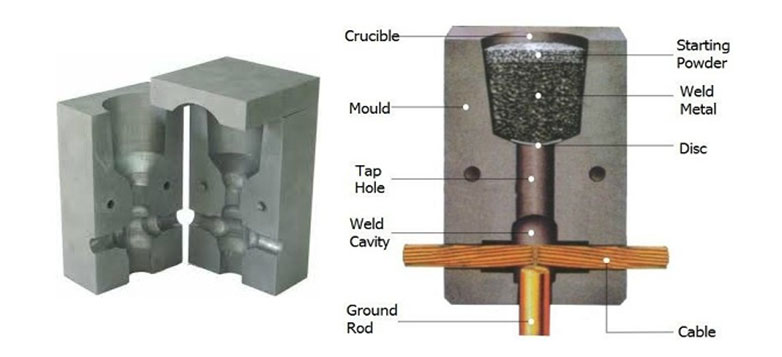
The exothermic weld process is a simple, self- contained method of forming high quality electrical connections. The compact process requires no external power or heat source, making it completely portable. Connections are made inside a semi-permanent graphite mould using the high temperature reaction of powdered copper oxide and aluminium.
An exothermic connection is actually a molecular bond formed between two metals such as copper/copper, copper/steel and steel/steel. Copper oxide and aluminium are combined and ignited.
The result is an Exothermic Reaction that produces molten super-heated copper and aluminium oxide slag.
The melting or fusing temperature rating of the finished joint is 2000°C plus. The molten super-heated copper melts the objects being connected together, forming the molecular bond.
This bond will not loosen over time or deteriorate with age. The connection’s current carrying capability is to that which it is being connected. In other words there is no increase in resistance in an exothermically weld connection as there is in most pressure connections.
The majority of exothermic weld connections have at least twice the cross sectional area of the conductors being joined, and an equivalent or greater current carrying capacity. Because the connection is a fusion of high conductivity, high copper content alloy, it will withstand repeated fault currents, and will not loosen in the way that mechanical connections can. Exothermic weld is a simple, economical method of making permanent, very high quality electrical connections – the process uses the high temperature reaction of copper oxide and aluminium, within a semi-permanent graphite mould, to form electrical connections mainly between copper to copper or copper to steel.
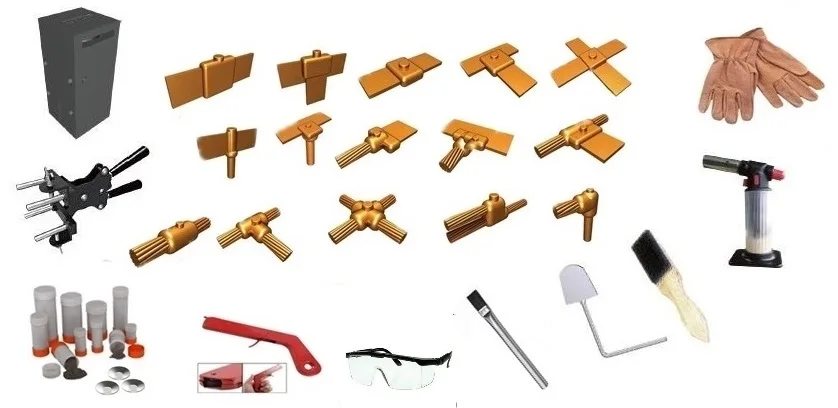
Exothermic weld requires no outside source of power or heat – the system is also light and portable ideal for field use. Making an exothermic weld joint is a simple procedure which requires a mould, weld powder, handle clamp and exothermic weld tools.
Exothermic weld connections are tolerant to repeated fault currents, highly conductive, permanent and demonstrate excellent corrosion resistance – most exothermic weld connections have at least twice the cross-sectional area of the conductors being jointed.
Exothermic weld is a very efficient and cost efficient method of making large or small numbers of high quality electrical connections. Exothermic weld is a simple self-contained system that uses the high temperature reaction of powdered copper oxide and aluminium, within a mould, to form permanent electrical connections. The Exothermic weld system requires no external power or heat source, creates high quality electrical connections, is completely portable, can be used safely with minimum training, is cost-effective and can be used for over 45 standard connection configurations. Exothermic weld connections have several advantages in that they are tolerant to repeated faults, are highly conductive, do not loosen and have excellent corrosion resistance because of the very high copper content (>90%) of the alloy.
An Exothermic weld connection produces a joint superior in performance to any known mechanical or pressure type surface-to-surface contact connector. By virtue of its molecular bond, an Exothermic Weld connection will not loosen or increase in resistance over the lifetime of the installation. Connections are often the weak point in ground circuits, especially if they are subjected to high currents and corrosion. The capacity of a grounding circuit to protect property and personnel depends on the quality of its connections. Only an exothermic weld connection can provide the permanent, low-resistance connection needed to create a long-lasting, reliable grounding network.
Exothermic weld is a process that achieves the molecular binding among two or more metallic conductors by a chemical reaction. This molecular binding improves mechanical, electrical and anti-corrosion properties compared with any mechanical connection. Exothermic weld is the best way to make permanent, reliable and high conductivity connections for any installation requiring an earthing system.
Exothermic weld is often used to join copper conductors. The welding process joins two electrical conductors by use of superheated copper alloy. An exothermic reaction requires no external heat or current source. The reaction occurs between a copper thermite compositions that heat the copper. The chemical reaction is aluminothermic, occurring between aluminum powder and copper oxides. The reaction reaches very high temperatures. Reactant powders and a spark is all that is needed for a high energy reaction.
Exothermic Weld System
Earth electrode and protective conductors are joined by exothermic weld process that employs superheated copper alloy to make permanent & maintenance free joint, avoiding unreliable screwed joints. The welding system is CPRI approved. Molding kits for all types of Grounding connections are available.